From donation to exhibition: A monumental bobbin lace registration project
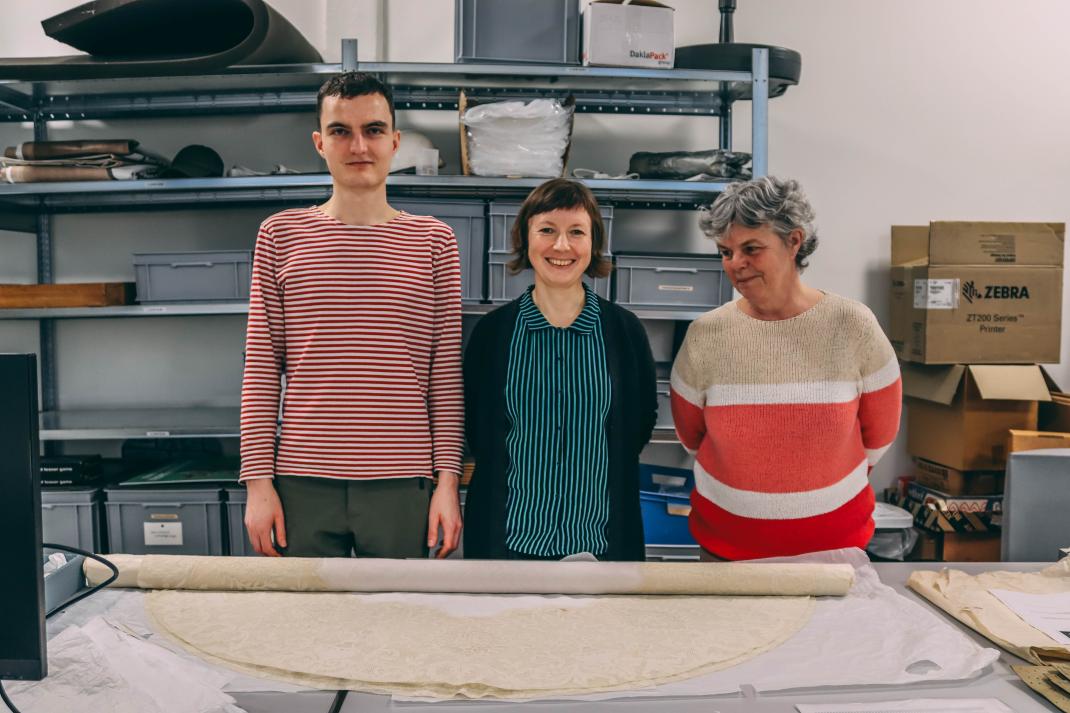
The Taxandria Museum in Turnhout, Belgium holds an extensive bobbin lace collection which is being researched and registered - with the help of a dedicated volunteer team - through scientific practices and methods including quantitative data collection, face-to-face interviews and imaging. Scivil spoke with lacemaker and volunteer Linda Coolen, lace researcher Sofie Wilder and lace registrar Marnix Steenackers about their collaborative work on this diverse lace collection. This work will culminate in a new exhibition at the Taxandria Museum in 2025.

The start of a monumental registration project
The Taxandria Museum is in the process of registering a vast amount of bobbin lace. How did this project come about?
Marnix Steenackers: 'The lace collection housed at the Taxandria Museum, part of Musea Turnhout, is extensive and diverse. We estimate that Musea Turnhout holds around 18,000 pieces of material culture in its lace collection, ranging from clothing and textiles to ephemera like design drawings, blueprints and photographs. Lace prickings, together with bobbin lacework and sample books make up the majority of the collection. With this registration project, Musea Turnhout aims to register and make digitally accessible part of its lace collection, through extracting and recording material culture (meta)data - a process facilitated by the volunteers’ practice-based knowledge in lacemaking.’
Sofie Wilder: 'The project began in September 2023. The first part of the project focused on catching up on a backlog; as Marnix mentioned, there is a large amount of bobbin lace in the collection that still needed to be described. This backlog partly arose from earlier donations, especially during the COVID years, when many people were clearing out their attics and basements and donated lace to us. In September 2023, we worked intensively with a group of volunteers to catalogue these items. After that month, Marnix and I adapted the manual we developed to guide volunteers in registering lace, as we had little experience in this area ourselves. Fortunately, we also have volunteers who make bobbin lace themselves and can interpret the technical aspects well.'
Linda Coolen: 'I started making bobbin lace in 1979. When this project began, I had just retired and signed up as a volunteer. It has become a new hobby for me.'
The role of volunteers
Are all the volunteers experienced bobbin lacemakers?
Sofie Wilder: 'Not all of them. About half have experience with bobbin lace, while the other half have received training from us. Even as a beginner, you can classify a lace sample by recognising certain features: is it Mechlin, Lille, Binche, or Turnhout lace, for example? There are so many different types of lace that we are all challenged by the diversity within the collection. Fortunately, we can rely on a network of contemporary lacemakers who help us identify lace fragments.'
Linda Coolen: 'That's true. If the team is unsure about something, we can always rely on our network to call in some assistance. Often, you recognise a piece of lace because you've seen something similar before.'
Sofie Wilder: 'We have lace samples from all over Flanders in the collection. We don’t always know how each item ended up in the Taxandria Museum’s collection, but our research is mainly focused on local bobbin lace from the Turnhout region.'
The registration process
How does the registration process work in practice?
Sofie Wilder: 'We started in September 2023 and have already processed about 400 pieces in that month alone. The group of volunteers works very efficiently together, and we certainly want to maintain that. Since then, we’ve been meeting every Friday, working with six volunteers, which seems to be the ideal number.'
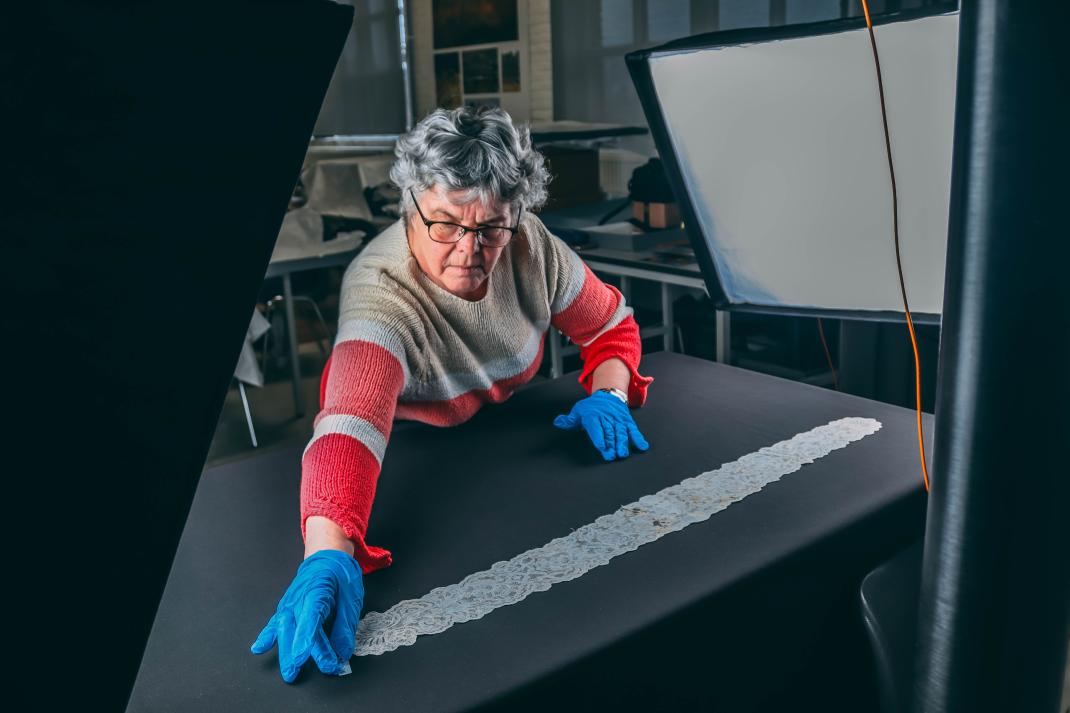
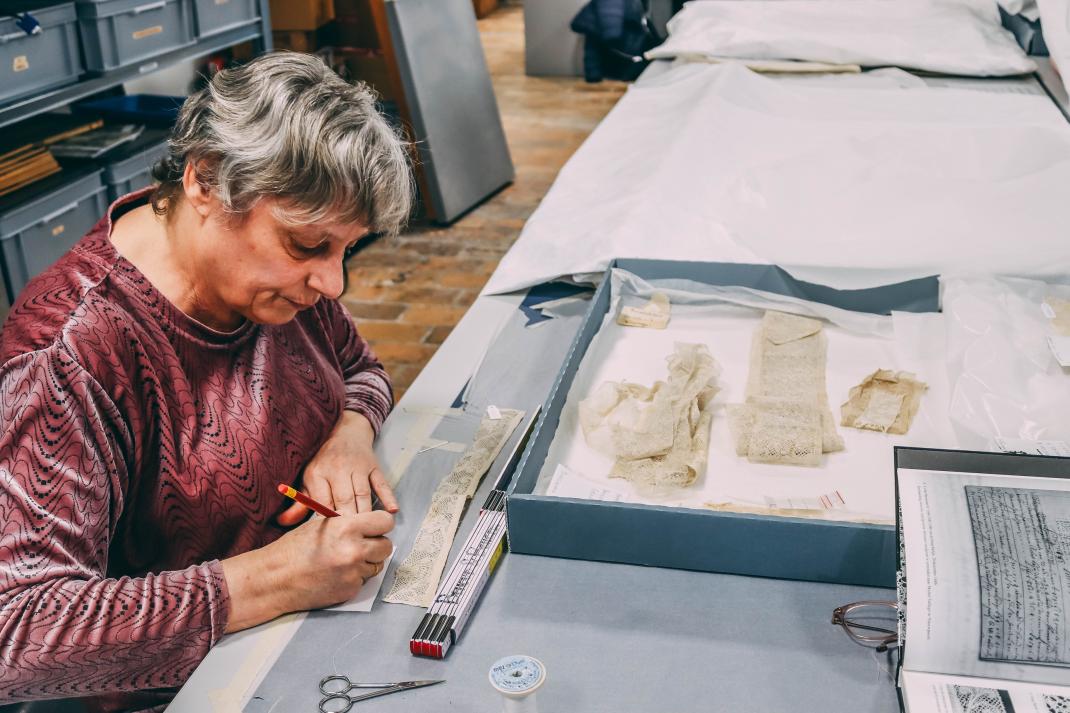
Marnix Steenackers: 'The registration process takes place in three stages executed collaboratively by the volunteer and museum team. During the first stage, the material culture is unpacked, examined and numbered, with a team member recording data such as dimensions, signatures, labels, stamps and copyrights. At the second stage, imaging takes place: all material culture is digitally photographed on the same black backdrop from varying perspectives, ensuring representational accuracy through the use of a colour calibration chart, reference scale and standardised studio lighting. During the third stage, the material culture’s (meta)data - incl. materialities/fibres, dimensions, techniques, oral histories - is digitally recorded as a dataset. This dataset is recorded with the aid of a standardised ‘lace vocabulary’, developed in Dutch by the Musea Turnhout team for this registration project. This ‘vocabulary’ is based on globally recognised thesauri and local Flemish lace terminology, in an effort to apply standardised terminology whilst recording idiosyncratic language amongst local lacemakers. A visual guide, consisting of verified
lace samples and photographs, was also developed by the Musea Turnhout team as a technical identification tool, to be used in combination with magnification, reference literature and the practiced-based knowledge held by the volunteer team.'
Linda Coolen: 'There is always someone from the museum present to answer questions and oversee the process. As ‘laypeople,’ we might otherwise photograph, label, or repack the pieces differently than the experts. Things are progressing well, but we still have a lot of work ahead with everything that’s left in the depot.'
What impact does the project aim to achieve?
Sofie Wilder: 'The registration project is a prime example of citizen science, where volunteers and professional researchers work closely together. Thanks to the expertise of the lacemakers, who are trained in the technical identification of lace types, we, as the museum team, have learned a great deal. Previously, we were often outclassed by their knowledge – they could immediately tell if something was Turnhout, Paris, or Valenciennes lace and from which period it dates. By now, we at the museum have mastered the basics and can even join in discussions on more complex issues. There has been a real exchange of knowledge between the lacemaking community and us as scientists. This collaboration has led to a deep partnership, where the volunteers have learned from our scientific methods, while we have benefited from their practical experience and technical skills. Moreover, the lacemakers have taken inspiration from the historical patterns they’ve discovered here, which has only fuelled their enthusiasm for a follow-up.'
There has been a real exchange of knowledge between the lacemaking community and us as scientists.
Challenges and lessons
Did you encounter any challenges during the registration process?
Sofie Wilder: 'It can sometimes be difficult to determine whether something was handmade or machine-made. The difference can be hard to spot.'
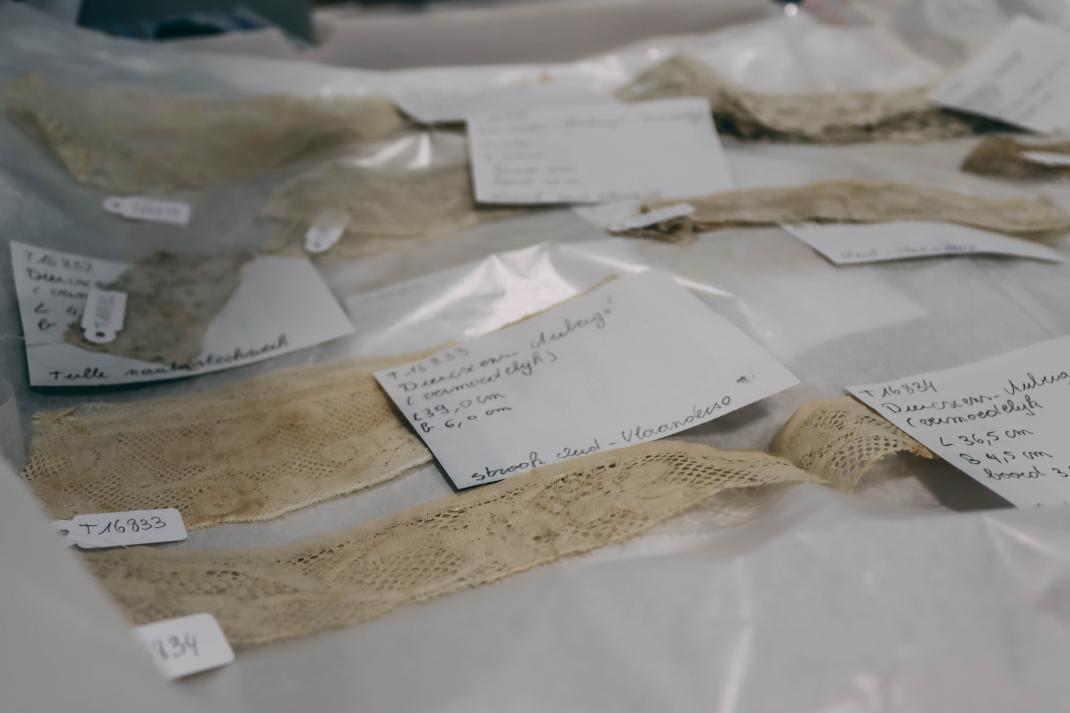
Linda Coolen: 'Dating pieces can also be a challenge. We often need to use a magnifying glass to see all the details. Identification often lies in those small details; you have to look at everything - the bobbin lace réseau, the shape of the plaits, the bobbin-lace stitch, the motifs used as filling, the background... And some decorations appear in different styles as well. Staying consistent with terminology is also something to watch out for.'
Sofie Wilder: 'Patience is another challenge. Initially, we thought we could work faster, but developing a good methodology turned out to be a slower process. For instance, we thought numbering the pieces would be relatively simple, but then volunteers asked where the label should be placed. We decided to put the number in the lower left corner, but even that raised further questions...'
Unique discoveries and future prospects
What is the most remarkable thing you’ve come across so far?
Linda Coolen: 'I came across a piece of lace in such poor condition that I would've almost thrown it away. After some research, it turned out to be from the late 16th century, and therefore very valuable.'
Sofie Wilder: 'We also discovered ‘war lace’ in the collection - lace that was made in Belgium during World War I and shipped to America. The best part is that, over time, you start recognising patterns and making connections between different pieces. It’s sometimes real detective work, with eureka moments when we can attribute a piece to a maker and bring someone out of anonymity. And I must admit: it has now become an addiction - I see lace everywhere.'
Marnix Steenackers: 'A lace pricking executed on late 19th century playing card-stock, linking Musea Turnhout's lace collection with its playing card collection, housed in the National Playing Card Museum in Turnhout, Belgium'.
What does the future hold?
Sofie Wilder: 'In 2025, the Taxandria Museum will present a new exhibition based on our research project, enriched with testimonies from lacemakers’ family members, letters, invoices, and registers. With this, we aim not only to show that handmade lace was a luxury product sold for large sums of money, but also to tell the story that might otherwise be lost: lacemaking demanded countless hours of blood, sweat, and tears from workers, often for a very low wage. That story must not be forgotten in the folds of history.'